Schroth Method for Scoliosis | Expert Non-Surgical Treatment NJ
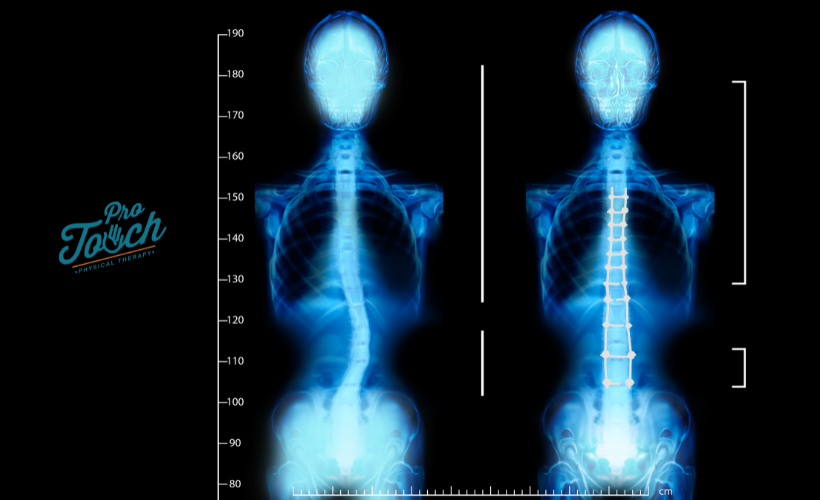
The Schroth Method for Scoliosis is a specialized form of physical therapy for a curved spine. It uses three-dimensional exercises and breathing techniques to de-rotate, elongate, and stabilize the spine. The method treats the sideways curvature of the spine as a twist in three directions at once, not as a simple side bend. Most people who want non-surgical scoliosis treatment ask the same question first. Can specific exercises really change a spinal curve? At ProTouch Physical Therapy in Cranford, NJ, the answer starts with an evaluation of your own scoliosis curve, because a program built for someone else's spine will not correct yours.
What the Schroth Method Is
Katharina Schroth developed this approach in Germany during the 1920s. She had scoliosis herself. She studied her posture in mirrors and learned to expand the collapsed side of her rib cage using directed breathing. Her daughter, Christa Lehnert-Schroth, built that work into a full clinical system. Certification programs later standardized the training, so credentials matter when you choose a provider.
Doctors confirm scoliosis when an x-ray shows a curve greater than 10 degrees. Being diagnosed with scoliosis does not automatically point to an operating room. Standard back exercises treat muscles. Schroth exercises treat a curve.
That difference drives everything else. Two patients with the same Cobb angle can need opposite positions. The right position depends on where the curve peaks and which way the trunk rotates. Certified therapists classify each curvature first. Only then do they assign the corrective exercises that match it. The ProTouch Physical Therapy team finishes that step before a patient does a single repetition.
How the Schroth Method Works
The Schroth method of physical therapy corrects posture from the inside out. The spine rotates, the rib cage follows, and the trunk collapses on the shorter side. The goal of Schroth training is to reverse that chain. Four principles do the work.
Curve-Specific Postural Correction
Your physical therapist individualizes every position around your curve pattern. You shift your pelvis, shoulders, and rib cage toward better spinal alignment. You then hold that position while you move. Mirrors, poles, straps, and wall bars give you constant feedback, so you learn to improve posture through active correction instead of passive stretching.
Rotational Angular Breathing
Breathing is the signature element of the method. You send air into the flat, collapsed areas of your rib cage while you limit expansion on the fuller side. Each breath pushes the collapsed ribs outward and helps untwist the trunk from within. Many patients breathe more easily within a few sessions, because ribs that had stopped moving begin to open again.
Muscular Stabilization and Postural Awareness
Holding a corrected spine takes endurance. Isometric holds train the muscles around your curve to keep that alignment without constant thought. Those neuromuscular gains then carry into daily movement patterns such as sitting, standing, walking, and lifting. This work pairs well with the postural training our therapists use for related alignment problems.
Home Program Integration
Office sessions build the skill. A daily home exercise routine builds the habit. Every patient leaves with a written program matched to their curve, usually a short set done most days of the week. Consistency at home predicts results more reliably than session frequency.
Who Benefits from Schroth Therapy
Scoliosis patients of every age can be evaluated, and therapists trained in this work treat scoliosis and kyphosis with the same three-dimensional logic. Strong candidates include:
- Adolescents with idiopathic scoliosis who are still growing and want to slow or stop curve progression
- Adults with degenerative curves that cause pain, stiffness, and fatigue after years of compensation
- Patients with scoliosis who wear a brace and need stronger muscles to support the correction the brace provides
- Pre-surgical and post-surgical patients working on trunk strength, breathing capacity, and posture
- People with Scheuermann's disease who need three-dimensional correction of a rounded upper back
Adults are the most underserved group. Most scoliosis information speaks to parents of teenagers. That leaves a 45-year-old with a 30-degree curve and daily back pain unsure whether therapy still applies. It does. Adult goals simply shift from curve reduction toward pain control, breathing capacity, and function, and those goals respond well to structured exercise.
Realistic Results You Can Expect
Honest expectations matter more than promises. Research on scoliosis specific exercise supports several outcomes. Your results depend on curve size, spinal flexibility, age, and how consistently you practice at home.
For Growing Adolescents
Curve stabilization is the main target. Scoliosis progresses fastest during growth spurts, so early intervention matters. Teens also build trunk strength and postural control that carry into sports and long study hours. Fall is a practical time to begin, since New Jersey school screenings often flag a spinal curvature early in the academic year.
For Adults with Established Curves
Therapy works to reduce pain first. Most adults report less pain during the ordinary tasks that used to aggravate them. Corrective positioning and breathing take load off the compressed side, and many patients gain endurance as stiff segments start moving again. Shoulder and waist symmetry often improves, though the amount varies from person to person.
Schroth therapy does not replace bracing or surgery for severe scoliosis or a fast-progressing curve. It works beside orthopedic care as conservative care. Your therapist will say plainly if your imaging suggests a surgical consult. Many patients consider it the best non-surgical choice among their treatment options. No honest provider claims that exercise alone erases a large structural curve.
What Schroth Treatment Looks Like in Cranford, NJ
Your first visit at ProTouch Physical Therapy is a complete evaluation. A Schroth-certified physical therapist reviews your imaging and history, measures posture and trunk rotation, tests strength and flexibility, and classifies your curve. That assessment produces a personalized treatment plan built around your specific needs, your goals, and your schedule.
Sessions run one-on-one, without time limits. That format matters for scoliosis physical therapy more than for almost any other physical therapy treatment, because corrective positions need hands-on cueing and constant adjustment. ProTouch Physical Therapy also treats the secondary problems that curves create, including neck pain, back pain, and hip and shoulder asymmetry, using manual therapy alongside your exercise program.
Scott Gander leads the clinical team with more than 20 years of orthopedic rehabilitation experience. The 2,000 square foot Cranford facility offers private treatment rooms on request. Appointments run from 7 am to 8 pm, which suits students and full work schedules.
Finding Scoliosis Care in New Jersey
Certified providers work across the state, from Monmouth County practices to hospital networks in Essex County, though availability is thin in some areas. Patients often compare Schroth physical therapy with chiropractic adjustments or general gym programs. The difference sits in the design. This approach to scoliosis addresses your curve pattern directly instead of treating the spine as a straight line. Ask these five questions before you commit to any treatment for scoliosis:
- Is my therapist certified in a recognized scoliosis exercise program?
- Will I see the same therapist at every visit?
- Do sessions run one-on-one or in a shared gym?
- How is my curve classified, and how does that change my exercises?
- What home program will I follow between visits?
Patients across Union County reach our Cranford office quickly, including families from Westfield, Clark, Kenilworth, Garwood, Springfield, and Elizabeth. Learn more about our scoliosis treatment program and how physical therapy for scoliosis fits into a full rehabilitation plan.
Take the Next Step Toward a Straighter, Stronger Spine
A curved spine does not have to dictate your posture, your comfort, or your activity level. The Schroth Method for Scoliosis gives you an active way to manage scoliosis without surgery. Effective scoliosis treatment starts with a program matched to your unique needs. Patients who commit to the work build a healthier spine, better daily function, and long-term scoliosis management they can carry on their own. Call ProTouch Physical Therapy at (908) 325-6556 or visit protouchpt.com to book your scoliosis care consultation in Cranford, NJ.